Opportunities
We are excited to announce several open positions at the Duan Lab at Shanghai Jiao Tong University for passionate and dedicated researchers. Our lab integrates machine learning and artificial intelligence with systems biology to comprehensively characterize genotypes, molecular phenotypes, and clinical phenotypes within the tumor microenvironment. We aim to unravel the complex relationships among these factors to advance the field of precision oncology. Positions Available are PhD Students, Postdoctoral Researchers, and Research Assistants.

🔬 RESEARCH
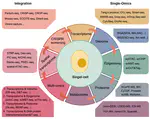
Cancer is a dynamic, multi-scale, and multi-modal system. Our laboratory aims to establish an AI-driven framework to understand, model, and engineer tumor states. By integrating artificial intelligence with systems biology, we develop interpretable computational approaches to represent tumor states, translate biological information across scales, and predict state transitions induced by genetic and therapeutic perturbations.Our long-term vision is to build a Tumor AI Virtual Cell (AIVC)—an intelligent model capable of understanding tumor states, simulating tumor evolution, and guiding precision oncology.
Tumor State Representation
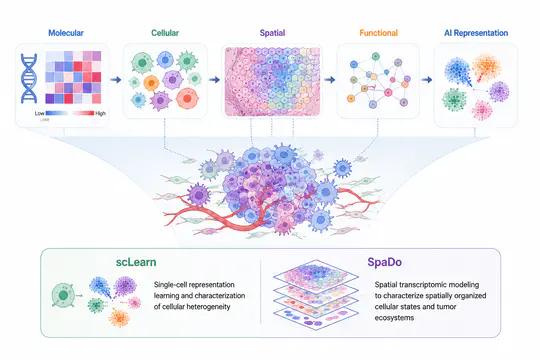
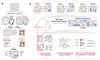
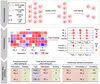
Tumors are not defined solely by genetic alterations or molecular subtypes, but by complex and dynamic cellular states emerging across multiple biological scales. We develop interpretable AI models to construct unified representations of tumor states from molecular, cellular, spatial, and functional perspectives. Representative Works: scLearn (Science Advances, 2020); SpaDo (Genome Biology, 2024).
Tumor State Translation
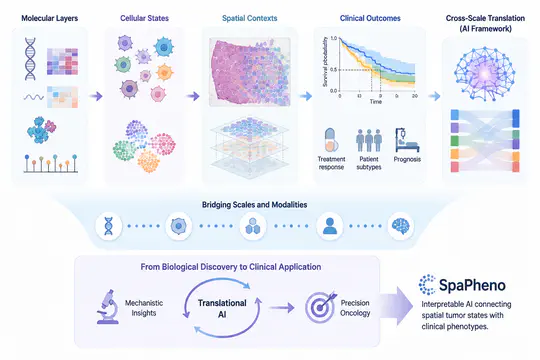
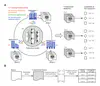
A major challenge in cancer research is how to translate biological information between experimental systems, molecular layers, spatial contexts, and clinical outcomes. We develop AI-driven frameworks to establish cross-scale and cross-modal mappings that bridge basic discoveries and clinical applications. Representative Works: SpaPheno (Genome Medicine, 2026).
Tumor State Perturbation
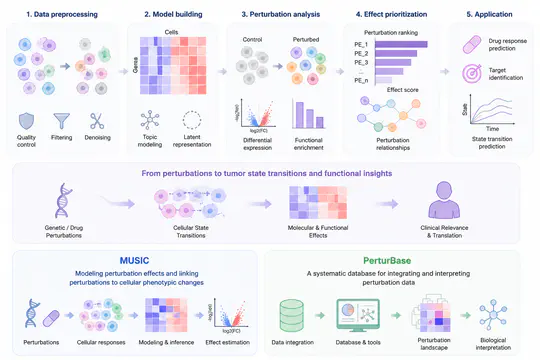
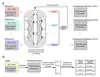
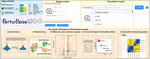
We aim to explore the immune and microbiome microenvironments of tumors, investigating their composition and function, as well as their impact on tumor development. By integrating multi-omics data, we seek to reveal how the tumor microenvironment influences cancer progression. Representative Works: MUSIC (Nature Communications, 2019); PerturBase (Nucleic Acids Research, 2025).
📃 PUBLICATION
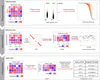
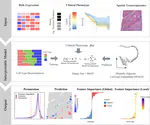
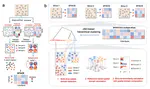
SpaPheno: Linking Spatial Transcriptomics to Clinical Phenotypes with Interpretable Machine Learning
In conclusion, SpaPheno demonstrates that interpretable machine learning, grounded in spatial principles of tissue organization, can systematically reveal where and why clinical phenotypes arise within complex tumor ecosystems. By integrating spatial embeddings, cell-type composition, and phenotype-informed attribution, SpaPheno moves beyond descriptive or black-box models, establishing a rigorous framework for mechanistic spatial inference. This approach is broadly applicable across diseases and data modalities, offering a scalable path toward spatially informed biomarker discovery and artificial intelligence assisted precision medicine.
👥 TEAM
Principal Investigator
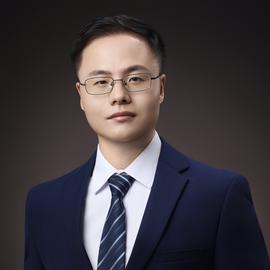
Bin Duan (段斌)
Associate Professor
Students
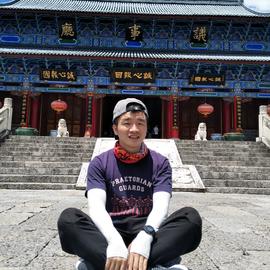
Hua Zou (邹华)
PhD Candidate (2025-)

Xinyu Zhu (朱欣雨)
PhD Candidate (2026-)
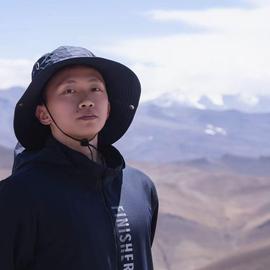
Zhiye Zhao (赵治烨)
Master student (2025-)

Mingli Luo (罗明立)
Master student (2026-)
Intern

Sufan Wang (王甦璠)
Remote Intern
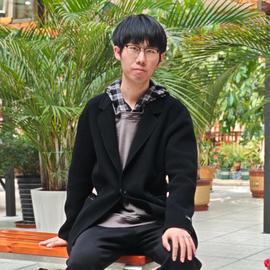
Fan Li (李凡)
Remote Intern
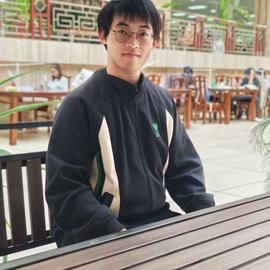
Yuxuan Lu (陆宇轩)
Remote Intern
🎫 EVENT
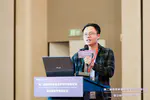
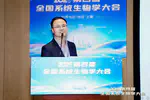
📨 CONTACT
- binduan@sjtu.edu.cn
- +65 83042333
- 800 Dongchuan Road Minhang District, Shanghai, Shanghai 200240
- Follow us on Github